
Key takeaways
- Bitcoin returned to $72,000 in May after Bitcoin ETP outflows reached $1.031 billion in the second half of the month.
- Data from Bitwise Europe shows that long-term holders reached an all-time high of 14.85 million BTC, or 74.3% of the supply.
- The $78,000-$85,000 area remains the key level to watch, with Polymarket’s odds for passage of the CLARITY Act in 2026 at 75%.
Bitcoin Reached $83,000 then crashed to $72,000 – here’s what rocked
The month opened with bitcoin crossing $80,000 for the first time since late January. The initial movement was largely mechanical. Perpetual funding rates were negative 21 out of 30 days in April, signaling crowded short positioning, according to Bitwise Europe researchers André Dragosch and Luke Deans. When these positions were unwound, approximately $42 million in short futures liquidations were cleared within 24 hours.
Global Bitcoin ETPs saw net inflows of $166.5 million in the first half of the month. Net realized profits and losses turned positive for the first time since the end of January. The sell-side risk ratio fell to its lowest level since October 2023, and long-term holders added around 125,000 BTC over the period, according to Bitwise Europe Report.
Sentiment peaked mid-month. The company’s Crypto Asset Sentiment Index reached its highest level in 12 months, with 13 of 15 sub-indicators above their short-term trend. Bitcoin also briefly touched $83,000 following reports of possible progress toward a de-escalation deal between the United States and Iran.
The second half completely reversed the trend. Global Bitcoin ETPs saw net outflows of $1.031 billion. THE Cryptocurrency Fear and Greed Index reinstated territory of fear. Bitcoin was rejected at the 200-day moving average near $82,000 and returned towards $72,000 to close the month.
A $29 trillion debt wall and a new Fed chair: what it means for Bitcoin
The Bitwise Europe report identifies a divided macro environment. On the one hand, global stocks continued to reach new all-time highs, supported by strong corporate earnings and positive growth revisions. On the other hand, sovereign bond markets are subject to increasing tensions.
Governments and businesses are expected to borrow $29 trillion in bond markets in 2026, 17% more than in 2024 and double the amount a decade ago, according to the report. The IMF has warned that markets are becoming less forgiving of sovereign borrowing assumptions. Yields on Japanese 10-year bonds rose to multi-decade highs during the month, a development Bitwise Europe sees as particularly significant given Japan’s roughly $7.5 trillion sovereign bond market and its status as the largest foreign holder of U.S. Treasuries.
Dragosch and Deans’ report notes that Strategy’s STRC perpetual preferred shares are trading below par, a headwind for new prospects. bitcoin purchases. Bitwise Europe Estimates Strategy represented approximately two-thirds of bitcoin demand via treasury companies and ETPs in 2026 to present.
Kevin Warsh was sworn as chairman of the Federal Reserve on May 22, succeeding Jerome Powell for a four-year term. Bitwise Europe’s natural language analysis of Warsh’s recent speech to the Senate Banking Committee characterizes his tone as slightly more hawkish than Powell’s. The firm notes that if the Fed keeps rates stable while inflation increases, the fall in real yields could recreate a historically favorable macroeconomic context for bitcoin.
14.9 million Bitcoin Locked up while traders retreat
Despite the attempted price recovery, on-chain activity in spot markets, derivatives, options and exchange-traded funds (ETFs) theaters were near annual lows throughout May, according to Bitwise Europe. The company notes that only 3.3% of recorded trading days saw a decline in the combined throughput of realized profits and losses, indicating widespread investor disengagement.
On the supply side, it’s a different story. Long-term holder supply hits record high of around 14.85 million BTCor about 74.3% of the circulating supply, according to the report. This supply is increasing at a rate 10.3 times higher than that of new monthly issues. In aging cohorts, 60.5% of all bitcoin hasn’t moved for more than a year, 48.5% for more than two years, 42.9% for more than three years, and 33.0% for more than five years, with all four cohorts trending upward.
Bitwise Europe identifies the $78,000 to $85,000 range as the current midpoint of market control, where the true market average, short-term holding cost basis, and US spot price lie. Bitcoin ETFs the basis of the overall cost all converge. The 200-day moving average sits at $80,500 within this band. According to the report, a decisive reconquest of the $85,000 zone would historically be a sign of a transition to a new bull market ride a bike.
Bitcoin at historic discount as Nasdaq trades near all-time highs
Bitcoin‘s market value to realized value ratio currently sits below 64% of its historical observations, according to Bitwise Europe, placing it in the bottom half of its long-term distribution. In contrast, the Nasdaq 100’s price-to-book ratio is near its highest level on record, with about 99% of historical values below the current level.
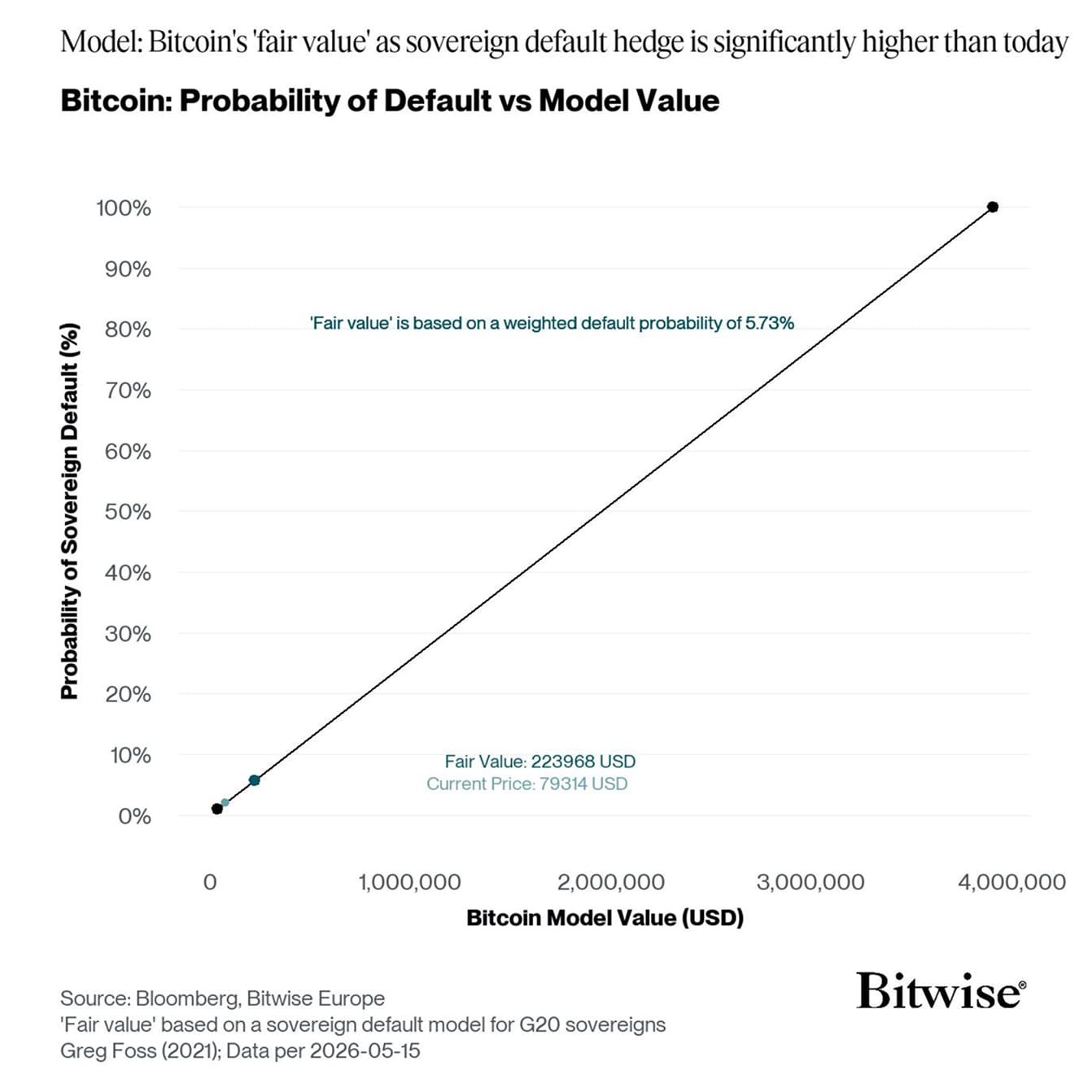
The report also references a theoretical model first proposed by Greg Foss in 2021, which estimates bitcoinThe illustrative fair value of as a sovereign default hedge at approximately $224,000 today, based on weighted default probabilities in the G20 sovereign bond markets. Bitwise Europe presents this as an implied figure from the model, not a price target.