
Key takeaways
- Ripple has joined the x402 Foundation alongside 40 organizations developing open payment standards for AI-powered internet transactions.
- Coinbase contributed x402 to the Linux Foundation to enable payment capabilities in HTTP interactions between AI agents, APIs and applications.
- XRP and RLUSD support x402 transactions, while wider adoption depends on integrations, usage, and ecosystem development.
Why Ripple joined the x402 Foundation
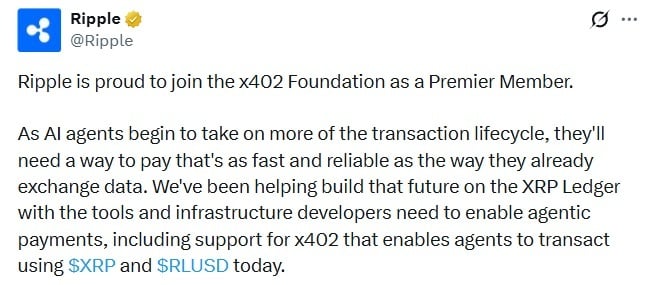
Ripple announced on July 14, 2026 that it had joined the x402 Foundation as a Premier Member, giving the company a role in the technical and governance development of the protocol. The foundation, which operates under the Linux Foundation, was created to support an open, vendor-neutral standard for payments over HTTP. Ripple membership connects the XRP Ledger’s x402 support is part of a broader industry effort focused on AI-driven payments infrastructure.
The x402 Foundation launched with 40 members across finance, cloud infrastructure, payments and blockchain sectors. Premier members include Adyen, Amazon Web Services (AWS), American Express, Circle, Cloudflare, Coinbase, Fiserv, Google, Mastercard, Monad Foundation, Moonpay, Ripple, Shopify, Solana Foundation, Stellar Development Foundation, Stripe and Visa.
General members include Aleo, Fireblocks, Galaxia Moneytree, Hecto Financial, Injective, Kakaopay, Kite AI, Layerzero Labs, Merit Systems, NEAR Foundation, Orthogonal, Polygon Labs, Quant Network, SKALE, t54 labs, Utexo, World Liberty Financial and Zerohash. Associate members include BSV Association, Cardano Foundation, Casper, Japanese Content Blockchain Initiative and OMA3. The group operates under open governance to develop an interoperable payment standard.
Ripple’s participation also highlights the XRP Ledger compatibility with x402. The company emphasized XRP Ledger infrastructure supporting agent payments via x402, including transactions using XRP and RippleUSD (RLUSD) stable coin.
How x402 Could Shape AI Business
The x402 protocol was provided by Coinbase to the Linux Foundation as an open standard for native payments on the Internet. It allows AI agents, APIs and applications to send and receive payments directly through web interactions, enabling software to exchange value alongside data. The protocol supports multiple payment methods, including traditional cards, stable coinsand blockchain-based assets.
The standard was designed to address a limitation exposed by AI agents. Software can already exchange information and access services, but the Internet infrastructure lacks a standard way for one program to pay another. X402 aims to provide a native payment layer for AI-driven commerce while supporting different payment methods.
Markus Infanger, senior vice president of RippleX, described Ripple’s role in supporting this development.
“We have built the tools and infrastructure to support this future globally. XRP Ledger, including x402 support which allows agents to transact using XRP and RLUSD today.
Linux Foundation CEO Jim Zemlin said the launch represented progress toward a community-run payments standard. “The operational launch of the x402 Foundation marks a critical step in establishing an open, community-driven standard for payments over HTTP. By bringing together leading companies in finance, technology and more, we are ensuring that the payments layer of the Internet remains neutral, highly interoperable and ready to support digital commerce.”
What’s left for XRP and x402 adoption?
Ripple’s membership gives the company a role in setting standards for machine-to-machine payments, while XRP and RLUSD are already supported in the x402 framework. However, x402 supports multiple payment methods, which means XRP will work alongside traditional payment systems, stable coinsand others blockchain networks as adoption grows.
Future adoption will depend on x402 being integrated into real-world applications by developers, businesses and AI platforms. Usage data will determine whether XRP and RLUSD are gaining significant activity within the ecosystem.
For now, Ripple has positioned the XRP Ledger as part of a broader effort to create payments infrastructure for AI-driven commerce. The foundation has attracted significant participants, but x402’s impact will depend on its actual implementation and use.