

Key points to remember:
- Iran reportedly fired on at least one tanker and turned away more than 20 ships on April 18, lowering Polymarket’s chances of normalization on April 30 from 41% to 28%.
- Strait of Hormuz May Normalization Market Holds at 69% Yes, Supported by $1.3 Million in volumeafter peaking at nearly 82% on April 17.
- A full “Yes” resolution requires IMF Portwatch to record a 7-day rolling average of more than 60 vessel arrivals by May 31, 2026.
Iran reimposed Hormuz restrictions hours after reopening; Polymarket contracts are evolving significantly
The Iranian Foreign Minister declared the strait “completely open” to commercial ships on April 17, citing a ceasefire negotiated by Pakistan. Oil prices fell about 10% following the news, stock markets rebounded and the May normalization contract was announced. Polymarket briefly touched intraday highs near 82%.
The reversal occurred within 24 hours. Iranian officials said The continued US naval blockade of Iranian ports constitutes a “breach of trust” and a violation of the terms of the ceasefire. The Polymarket contract of April 30 fell 41% from its recent peak. The May contract, which had reached 73% on April 17, returned to about 69% Yes from April 18.
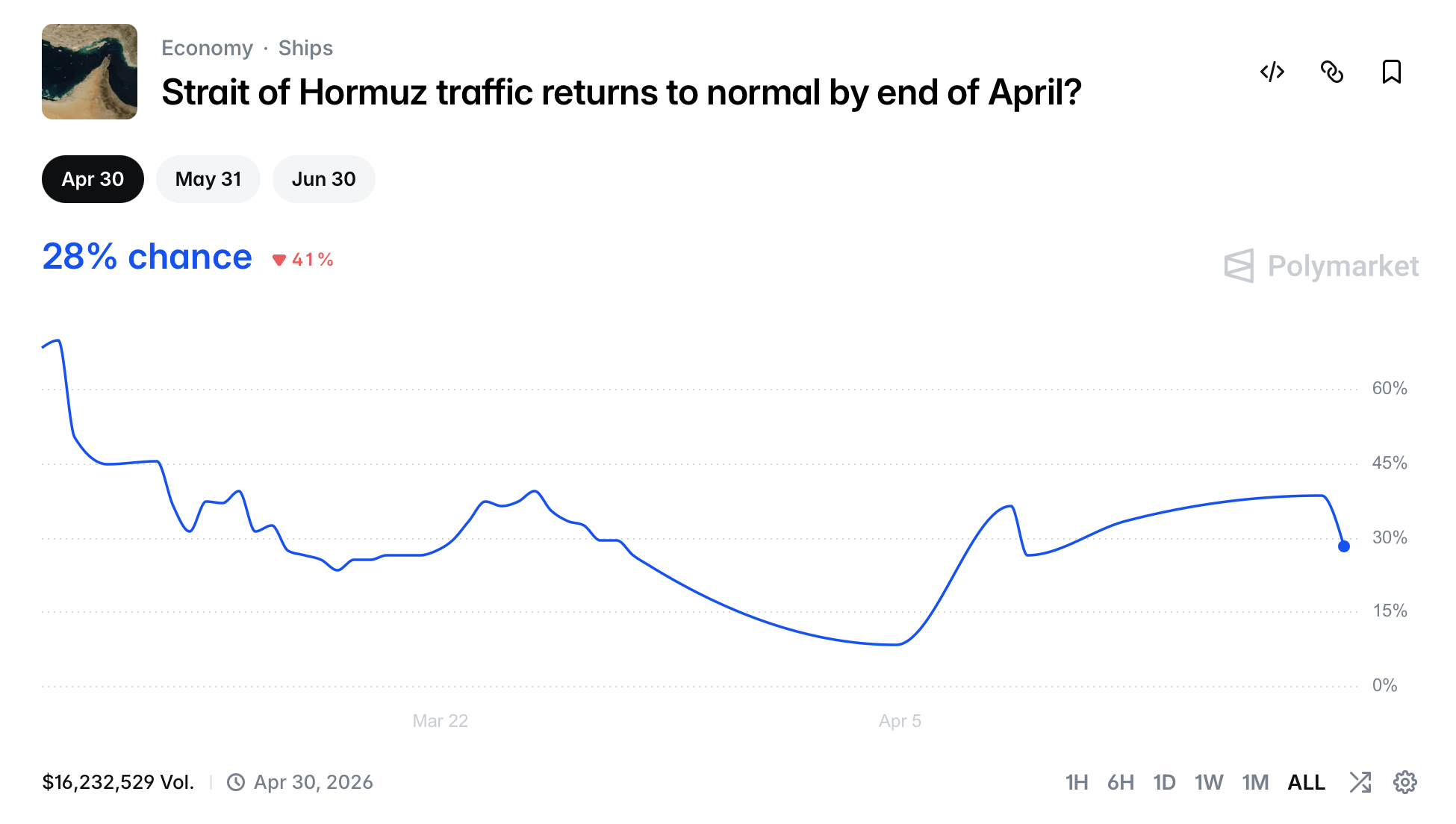
April 30 market brings in more than $16 million in total volumewith nearly $4 million changing hands in a single session on April 7, following Iran’s earlier pledge to reopen the waterway.
The resolution of the two contracts depends on IMF Surveillance Port reporting a 7-day rolling average of at least 60 vessel arrivals covering container ships, dry bulk, ro-ro, general cargo and tankers. Before the crisis began in early March 2026, daily calls on public transport regularly exceeded 60 by this measure. The current ship count is between 5 and 16 ships per day.
Kpler data shows that 8 tankers transited early Saturday before the crackdown resumed. MarineTraffic recorded several vessels making U-turns near Larak Island after Iranian measures resumed.
The calculation of the April 30 contract presents an obstacle beyond the political situation. The seven-day moving average has been near zero for weeks. Even with an immediate and full resumption of commercial traffic, reaching an average of 60 ships in the remaining 12 days would require a level of throughput that traders appear unwilling to price as likely.
THE Strait of Hormuz carries around a fifth of the world’s seaborne oil and significant volumes of LNG. Iranian forces declared it effectively closed around March 4, 2026, following U.S. and Israeli military operations against Iran that began in late February. At least 10 ship attacks were reported in early March.
President Asset He publicly welcomed the April 17 announcement, but said the U.S. blockade would be maintained until a comprehensive deal was reached. On Saturday, the White House maintained this position.
A Polymarket companion market being normalized by the end of June is approximately 81% Yeswhich suggests that traders view a long-term resolution as more likely than a short-term stabilization. Insurance premiums for ships attempting to transit Hormuz remain significantly high. Shipping companies have largely suspended their crossings while awaiting clearer security guarantees.
Pakistan served as an intermediary between Washington and Tehran. No formal negotiations are currently planned and no timetable for a broader agreement on Iran’s nuclear program has been announced.
The April 30 contract will be resolved as soon as IMF Portwatch publishes eligible data, or on the deadline if no eligible data appears. With 12 days remaining and daily ship counts in the single digits, the 72% no reflects where most of the capital has settled.