
Strive’s SATA preferred stock has recovered nearly 16% from its June low to about $97, prompting Jan3 CEO Samson Mow to predict that the rally could help Strategy’s STRC return to its $100 face value.
Summary
- Strive’s SATA has recovered nearly 16% from its June low to approximately $97.
- Samson Mow hopes SATA’s recovery will help Strategy’s STRC regain its $100 face value.
- Three major U.S. preferred stock ETFs collectively own $756 million in STRC.
Data from Yahoo Finance shows that SATA has risen from $83.30 and is now trading within about 3% of the level it was designed for. The recovery has erased most of the preferred stock’s decline in late June, while STRC remains around 13% below par despite receiving increased demand from major US exchange-traded funds.
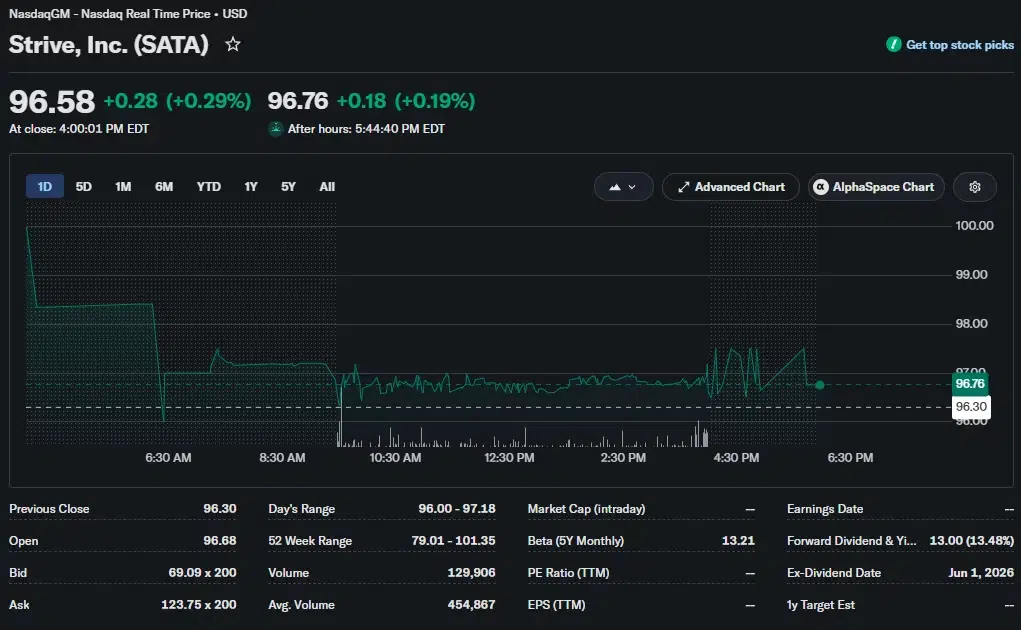
According to Mow, steps taken by Bitcoin treasury companies to improve their balance sheets and support their preferred shares have begun to rebuild confidence in the products. He told Cointelegraph that SATA’s return toward $100 could reassure investors that the funding structure used by Strive and Strategy remains functional.
“I think all the actions Strategy has taken to strengthen its balance sheet and encourage STRC to return to parity are also working.”
Mow expects the two stocks to move together because investors are assessing whether Bitcoin-linked preferred stocks can continue to fund their dividends and stay close to their stated values.
“But it all works together. I think as SATA gets back on track, we’ll see STRC get back on track as well, because people are saying, ‘OK, this model is not broken.’ Everyone is capitalized by three or more years of dividend payments… there was no reason to panic at all times,” he added.
SATA Recovery Supports Confidence in Bitcoin Preferred Stock
Strive introduced SATA in November 2025 to raise money to expand its Bitcoin holdings without issuing more common shares. Variable Rate Perpetual Preferred Stock uses dividend adjustments to encourage trading around its $100 par value.
By changing the payout rate when necessary, Strive can make SATA more or less attractive to investors as its market price changes. The company designed the structure to provide recurring access to capital while limiting dilution to common shareholders, consistent with its stated treasury strategy.
The strategy launched STRC in 2025 under a similar model. The preferred stock also uses a variable dividend to keep its price near $100, putting it in a category Strategy calls “digital credit.”
During the late June sell-off, both products fell well below their expected levels. SATA has since recovered to around $97, but data from Yahoo Finance shows that STRC closed at $86.89 on July 24 after gaining 2.29% during the session. It later rose to $87.14 in after-hours trading.
Mow sees the difference in their recoveries as temporary and not proof that STRC’s structure has failed. His forecast relies on investors treating SATA’s rally as proof that Bitcoin’s corporate-backed preferred stock can rebound after a sharp decline.
In addition to the price recovery, Mow noted that companies are refining how they raise capital and manage their Bitcoin holdings. He cited Lyn Alden’s Orange Juice treasury company, launched on July 15, as an example of a new entrant using a different operating model and starting with a lower Bitcoin acquisition cost.
BitcoinTreasuries ranks Strategy as the largest corporate Bitcoin holder, with 843,775 BTC. Strive owns 19,921 BTC, ranking it seventh among public companies tracked by the platform.
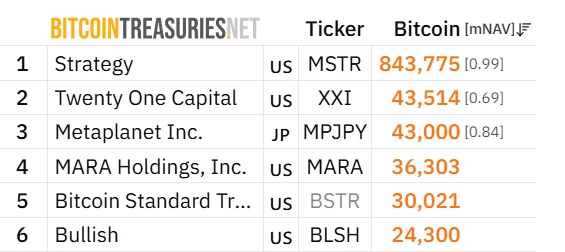
Those holdings create different levels of exposure to Bitcoin, but both companies rely on capital market products to support their treasury plans. For Strive, SATA offers a path to fresh funds without selling more common stock, while Strategy uses STRC and other securities to fund additional Bitcoin purchases.
ETF Demand Strengthens STRC Despite Its Discount
Institutional demand has already put STRC at the top of three large US preferred stock ETFs.despite the fact that the value continues to trade well below par.
Michael Saylor, co-founder and CEO of Strategy, revealed on July 24 that STRC is now the largest holding in BlackRock’s iShares Preferred and Income Securities ETF, Virtus InfraCap U.S. Preferred Stock ETF, and VanEck Ex-Financial Preferred Securities ETF.
According to figures shared by Saylor, the three funds collectively own $756 million of STRC. Their portfolios also contain preferred stocks issued by established US companies, giving ETF investors indirect exposure to Strategy’s Bitcoin-linked security alongside traditional income products.
In his X post, Saylor presented the ETF holdings as evidence that Strategy’s “digital credit” securities are entering institutional portfolios. The holdings show that asset managers have allocated substantial capital to STRC, although its closing price on July 24 remained 13.11% below $100.
The STRC discount is important to Strategy because the company sells the preferred stock to fund Bitcoin purchases. The strategy can issue shares near or above par and direct profits into Bitcoin, but a large discount reduces the amount of capital it can raise from each newly issued share.
Therefore, selling more STRC while it trades around $87 would produce less funding per share than a completed issuance near $100. The lower price could weaken the economics of using the security for Bitcoin accumulation, even if existing ETF demand continues.
Mow’s perspective links SATA’s recovery to a possible improvement in those conditions. If investors interpret Strive’s return toward par as evidence that variable rate Bitcoin preferred shares can stabilize, their view suggests that STRC could attract enough demand to reduce its discount and restore a more efficient funding channel for Strategy.