Key takeaways
- A year after bipartisan House passage, the CLARITY Act still has not delivered the comprehensive market structure promised to the U.S. digital assets industry.
- The anniversary highlights the growing gap between Washington’s support for crypto innovation and its ability to establish lasting, enforceable rules.
- The Senate’s action now poses a broader test of whether the United States can transform its financial leadership ambitions into a functioning digital asset framework.
A year later, the CLARITY law remains unfinished
A year after the House passed the CLARITY Act, the central question is whether bipartisan support can produce a sustainable digital asset framework before another year of uncertainty passes.
Passage of the bill by the Senate could establish clearer rules, strengthen consumer protections and give financial institutions greater confidence in participating. A continued delay could leave exchanges, developers and investors facing unresolved questions regarding asset classification, registration and federal oversight.
House lawmakers marked the anniversary with a July 17 hearing at Federal Hall National Memorial in New York, titled “Building the Future of Finance: How the CLARITY Act Unlocks Innovation.” The hearing examined how clear rules could encourage entrepreneurs, developers and financial institutions to build and invest in the United States.
Rep. Warren Davidson framed the anniversary as a test of Congress’s follow-through.
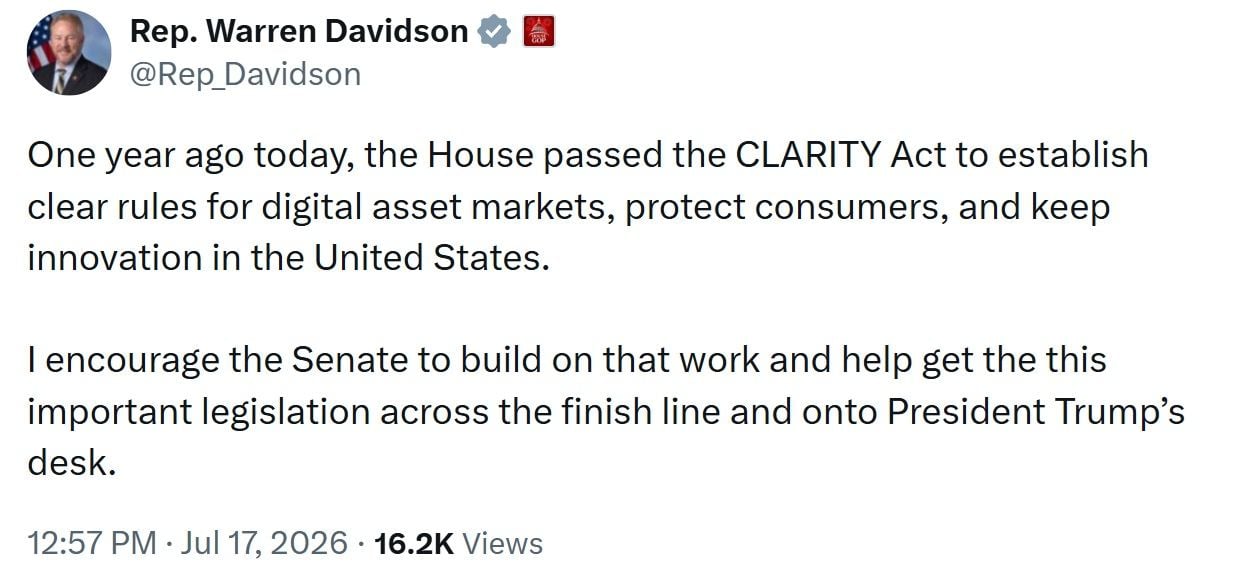
The House has established a policy goal, but without Senate adoption, the promised certainty remains aspirational. For digital asset companies, this gap can influence where they operate, how they structure their products, and whether or not they commit capital to the U.S. market.
Emmer turns bipartisan passage into Senate delay measure
Nearly 80 Democrats joined Republicans to pass the CLARITY Act, giving it unusual bipartisan legitimacy. But a year later, that vote also became a measure of legislative inertia.
House Majority Whip Tom Emmer blamed the Senate for the delay.
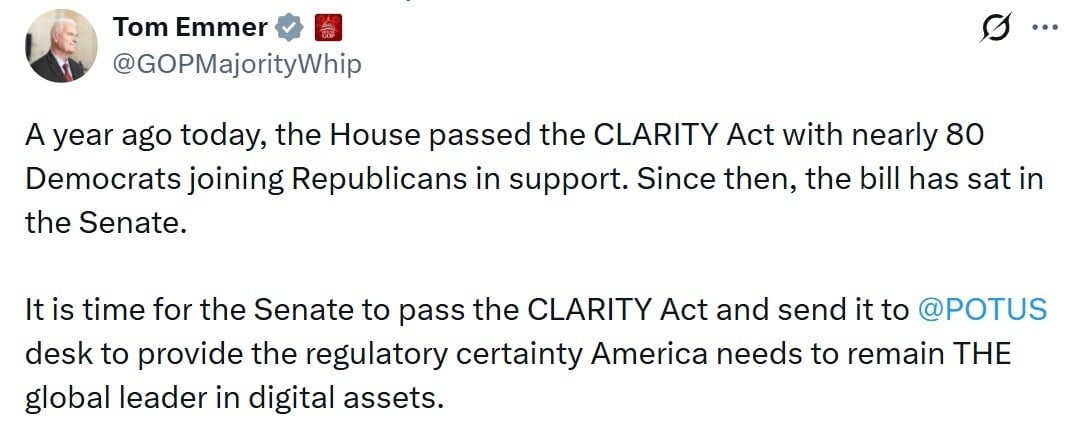
The strongest bullish the proof is the durability of the support. Lawmakers continue to hold hearings, coordinate public statements and present the bill as essential to America’s financial competitiveness.
The strongest bearish the proof is the lack of measurable progress in the Senate. Continued advocacy keeps the bill relevant, but each month without committee approval, markup, or vote weakens expectations for near-term passage.
Federal Hall hearing links regulatory clarity to market development
The hearing at Federal Hall brought together representatives from blockchain infrastructure, digital asset trading, asset management and crypto policy.
Witnesses included Sarah Aberg, legal director of Nova Labs; Randi Abernethy, Head of Clearing and Group Risk at Bullish; Ryan Louvar, legal director at WisdomTree; and Jason Somensatto, policy director at Coin Center.
The witness list reflected the scope of the bill beyond crypto price. The CLARITY Act could shape how developers launch networks, exchanges list assets, asset managers design products, and institutions assess exposure.
Rep. Bryan Steil argued regulations haven’t kept pace blockchainmaturity.
” Blockchain the technology has now been around for over 15 years. It’s no longer a theoretical concept, it’s a practical technology that powers real businesses, real networks, and real economic activity.
“Yet, despite its maturity, entrepreneurs and developers still face great uncertainty about how digital assets are classified and regulated,” the lawmaker added.
Clearer standards could reduce compliance risks and make the United States more attractive to businesses and financial institutions. Yet “regulatory clarity” does not guarantee an achievable outcome. The impact of the bill will depend on its final wording, the distribution of powers between regulators and its consistent implementation.
Hill says market structure is the missing piece
House Financial Services Committee Chairman French Hill argued that the CLARITY Act is critical infrastructure for the broader digital asset economy.
“We are here at Federal Hall in New York to hold a field hearing to commemorate the one-year anniversary of the passage of CLARITY with 78 Democratic votes last summer. …We need CLARITY in place because of a key point I always make: if you have GENIUS and backed by the dollar. stable cointhat President Trump signed into law last July, but you don’t have a market structure bill, you got permission to have a cell phone but no cell network.
“There is no ecosystem to support usage, which is why it is so critical that we pair complementary legislation with GENIUS implementation and sustained dollar funding. stable coins“, he continued.
Hill’s analogy moves the debate from an isolated debate crypto bill to build a working system. Stablecoins can operate under federal rules, but the broader market still needs standards governing how digital assets are issued, traded and supervised.
The potential benefit is structural rather than immediate catalyst for crypto price. Adoption could give businesses and institutions greater confidence in making long-term decisions about products, investments and operations in the United States.
The next catalyst is measurable movement in the Senate. An agreement from the committee, a markup or a scheduled vote would show that this anniversary marks new progress. Without it, this step will highlight Washington’s continued struggle to become bipartisan. crypto ambitions into applicable rules.