Key takeaways
- On May 7, peak demand of 15,579 MW prompted Venezuela to reiterate measures banning bitcoin mining.
- The ban impacts local miners, reflecting a 2024 Russian Energy Ministry policy that saved 300 MW.
- Despite the bans, reports explain that Bitcoin mining offers untapped potential to exploit stranded energy sources.
Venezuela reiterates Cryptocurrency Ban on mining, says illicit mining activities will be punished
Cryptocurrency Mining, as an energy-intensive activity, continues to face restrictions in several countries due to its impact on local energy networks.
The government of Venezuela has issued a statement reiterating the current ban on digital mining operations, as the country faces peak energy demand, which has led to electricity rationing measures affecting citizens.
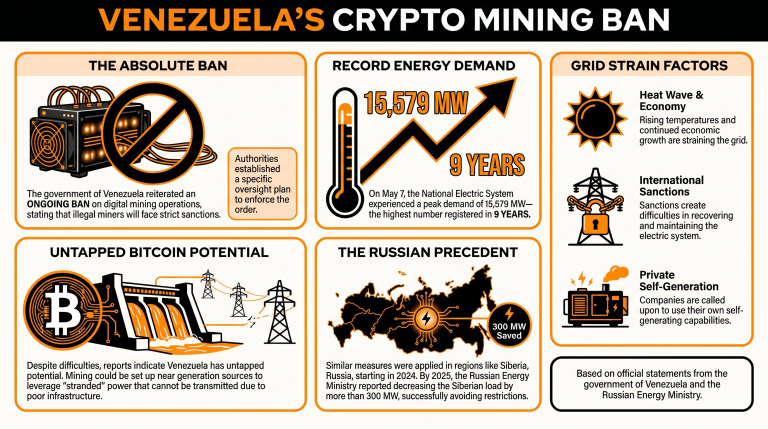
THE statement pointed out that on May 7, the National Electric System experienced a peak demand of 15,579 MW, the highest figure in 9 years, attributing this increase to the ongoing heatwave and the continued growth of the country’s economy.
Concerning crypto mining, he declares that “The absolute ban on digital mining on national territory is maintained. Those who illegally use this activity will be punished as provided by law.” In addition, authorities have established a monitoring plan to enforce this order.
The government also cited international sanctions as a factor in the difficulties in restoring and maintaining the national electricity system, and called on private companies to effectively use their self-generation capacities to help maintain the stability of the grid.
Finally, the government announced that it would present a plan to restore and transform the national network.
Despite these challenges, reports indicate that Venezuela has untapped development potential. bitcoin miningas bitcoin operations could be located near production sources to leverage energy that cannot be transported due to lack of infrastructure.
This measure is similar to that which the Russian government has applied since 2024 in regions such as Siberia, also affected by energy shortages. In February 2025, the Russian Energy Ministry said that these measures had reduced the load on the Siberian grid by more than 300 MW, thereby avoiding restrictions.